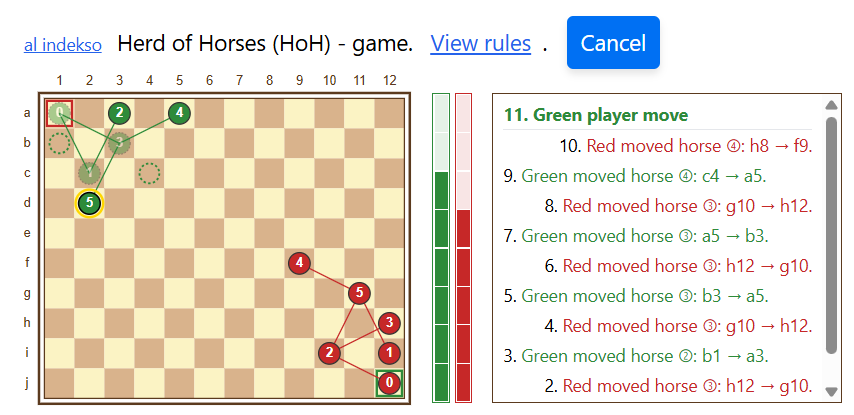
Herd of Horses (HoH) is a game for two players: Green and
Red. Each player has a herd of horses. The horses move like the knight in chess.
The goal is to bring any one of your horses to the opposite corner of the board.
The catch: a herd must always stay together.
A game in progress. Green has selected horse 5 (yellow ring); the dotted circles show where it can jump.
Faded horses cannot move right now. Between the board and the moves log are the two progress bars.
Setup
Players:
Two players - two people play on the same screen, taking turns.
One player (against computer) - you play Green, the computer plays Red.
The computer picks a random horse that can move and moves it to a random possible cell.
It does not move the same horse straight back to where it came from, unless there is no other move.
Width of the board: from 8 to 30 columns.
Height of the board: from 8 to 20 rows.
Horses: from 4 to 10 horses for each player.
Press Start to begin.
The board
The board looks like a chess board. Rows are marked with letters a, b, c, … from top to bottom,
columns with numbers 1, 2, 3, … from left to right. A cell is named by its row and column,
for example a1 is the top-left cell and d5 is row d, column 5.
Starting position
The Green herd starts in the top-left corner,
the Red herd in the bottom-right corner.
The horses are placed randomly, but close to their corner. Green horse 1 always stands on a1,
Red horse 1 always stands on the bottom-right cell.
Every horse has a number 1, 2, … 9 shown inside its circle; with 10 horses the tenth one is 0.
Every herd starts connected (see below), and each player has at least one possible move.
Connected herd
Two horses of the same player are connected when one could jump onto the other with a knight move.
Connected horses are joined by a thin line in the player's color.
A herd is together when you can walk along these lines from any horse to every other horse of the herd.
The herd must stay together after every move.
How a horse moves
A horse jumps like a chess knight: 2 cells in one direction and 1 cell to the side (an "L" shape).
. X . X .
X . . . X
. . H . .
X . . . X
. X . X .
A horse H can jump to any cell marked X, if:
the cell is on the board;
the cell is free (no horse of either player stands there) - there is no capturing;
after the jump the whole herd is still together.
Horses jump over other horses freely, like a knight in chess.
A turn
Green moves first, then the players take turns. Each turn you move exactly one horse.
Click one of your horses to select it. It gets a yellow ring.
The cells where it can jump are shown as dotted circles.
Click one of the dotted circles to move the horse there.
Click the selected horse again to unselect it, or click another of your horses to select that one instead.
Horses that have no legal move right now are drawn faded with a dashed outline, and you cannot select them.
Keyboard
Press a digit 0 - 9 to select your horse with that number. Press it again to unselect.
The dotted circles are marked with letters a, b, c, … (from top to bottom,
left to right). Press the letter to move the selected horse there.
Winning and losing
Green wins when any green horse reaches the bottom-right cell
(outlined in green).
Red wins when any red horse reaches a1, the top-left cell (outlined in red).
A player who has no legal move on their turn loses.
Note: at the start each target corner is occupied by the opponent's horse 1. That horse has to move away
before the corner can be taken - and it does not have to leave. Defending your home corner is part of the game.
What you see on the screen
Board - the horses, the lines between connected horses, and the two target corners.
Progress bars - one green and one red bar between the board and the log. The bar is divided
into as many parts as a knight needs to go from a1 to the bottom-right corner on an empty board.
The filled part shows how many knight moves the player's closest horse still needs to reach its target.
The shorter the bar, the closer the player is to winning. It is only an estimate: it ignores other horses
and the rule that the herd must stay together.
Moves log - on the right. The top line says whose move it is (or who won).
Below it are the moves, the newest first, for example
"3. Green moved horse ⓪: a3 → b5." Green moves are on the left, Red moves on the right.
Cancel - stops the game and returns to the setup. After the game ends it becomes New game.
Tips
A horse on the edge of the herd usually moves most freely. Horses in the middle often hold the herd together.
Move the whole herd forward step by step: a single horse cannot run far away alone.
Your horses can block cells the opponent needs. Standing near your home corner can stop the enemy.
Be careful not to block your own herd - if none of your horses can move, you lose.